
Validation work can become a release bottleneck.
Engineers work in GitHub and Jira, while the traceability matrix often sits in a separate spreadsheet. Over time, the two can drift apart. By the time a release is ready, QA may have to go back through weeks of changes to reconcile them.
That reconciling pulls engineers off planned work and pushes out releases, and it can leave gaps in the validation record. GxPForge keeps the traceability links from the systems your team already uses, and it generates the validation documents when you need them.
GxPForge reads from GitHub, Jira, Trello, Excel, and JUnit results. Pull requests and test runs can be used as validation evidence without entering the same information again.
Each release has a dashboard showing coverage, open gaps, and a countdown to the target date. This gives the team time to deal with gaps before the release is due.
An append only audit trail, electronic sign off and locked approved records are built into the platform. Traceability reports can be exported as Word or PDF when needed.
A traceability matrix that stays current as the underlying records change.
{{ f.title }}
{{ f.body }}
Controls for audit trails, electronic sign off, access, approved records and segregation of duties.
The audit trail is append only and enforced at the database level. Sign off asks for the password again, access is checked by role on every write, records lock once approved, and duties are segregated. Whether a given deployment satisfies a specific regulatory obligation is for your QA and regulatory function to decide.
See the controls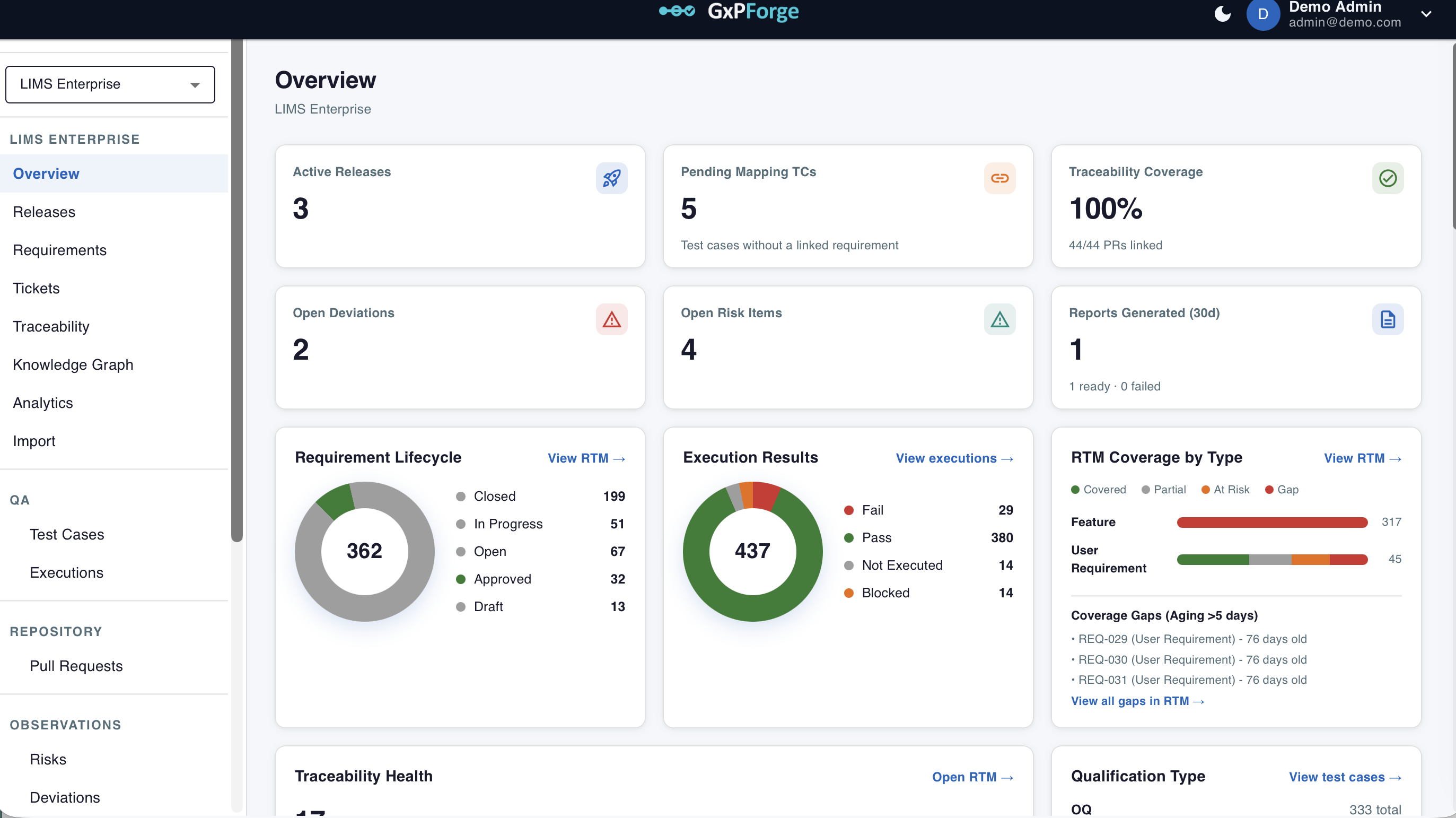
See where each release stands.
Group requirements into releases with a status and target date. Each release gets a full dashboard with coverage, countdown, pull requests, test breakdowns, a heat map and recent activity, and you can keep several release dashboards open side by side.
Releases and dashboards
Validation work that stays connected to engineering
See how GxPForge works with your GitHub and Jira workflow, and which validation tasks can be handled without maintaining a separate spreadsheet.
Book a demo